MSU-SG7
Solar gateway
- Always on: continuous listening
- Collects master and slave units over LoRa
- No limit on the number of nodes
To the platform: IP networkDatasheet for the MSU-SG7

The solution architecture
The DigitalWan solution links multi-measurement sensors to a monitoring platform through a self-sufficient wide-area network. MSU-SD7 slave units transmit over LoRa to the MSU-MD7 master unit, which relays the data to an MSU-SG7 gateway over LoRaWAN 868 MHz, or straight through the mobile network over LTE-M or Cat-1 bis. The MSU-XD7 and MSU-LD7 standalone units, for their part, transmit directly over LTE-M, with no gateway or master unit.
SU-CD7 and MSU-SD7 · Slave units
To the master unit, or straight to the gateway over LoRaWAN
MSU-MD7 · Master unit
Measures, collects up to 5 slaves and relays the data
MSU-SG7 gateway or GSM relay
Continuous listening or mobile network, with no local infrastructure. The MSU-XD7 and MSU-LD7 standalone units transmit straight to the mobile network over LTE-M.
DigitalWan platform
Monitoring, alerts and API, on web and mobile
The building blocks
Combine gateway, master unit and mobile network according to the size of the site, its coverage and its access to power.
Solar gateway
Master unit
Mobile network, no gateway
Sense
Every device in the range carries the same measurement components. The wireless option is identical on the slave unit and the master unit.
Ambient temperature and temperature inside the enclosure, from −40 to +125 °C.
3-axis accelerometer: tilting, inclination, theft and vandalism.
Detects the cover being opened and changes to darkness.
Fill level, distance measurement and presence detection.
External inputs
The two channels are independent and each one can be set up as a probe or a dry contact, on the MSU-MD7 and MSU-SD7 units.
Remote wired sensors: temperature, level, ultrasonic and humidity, connected over I2C or PSI. J4 connector with an IP68 waterproof cable gland.
On/off signals: opening, alarm, limit switch and pulse counting, with built-in interference and bounce suppression.
Detection modes
Depending on the configuration, each sensor runs two of the following detection modes, selected from the platform.
Examples in telecom chambersChange of orientation on three axes compared with a reference position.
Movement of the sensor, measured by the built-in accelerometer.
Vibrations detected by the built-in accelerometer.
Presence detection using infrared.
Change in light or lighting conditions, for example when a cover is opened.
Detection of hydrogen sulphide.
Geolocated tracking of fibre optic cable deployment, metre by metre.
Connect
Two synchronised transmission technologies and an encrypted chain: the data gets through, even if one network goes down.
Long-range radio link between the sensors and the master unit, with no subscription.
Ethernet or Wi-Fi to connect the gateway to the platform.
Mobile operator network through the built-in MFF2 eSIM.
Two transmission technologies provide active redundancy and service continuity, even if one channel fails.
Data is synchronised across two separate technologies, encrypted end to end and aggregated on secure platforms.
Real-time collection and analysis, assisted by artificial intelligence, to automate monitoring and react quickly to anomalies.
The solution works with existing equipment and platforms, and is available as a white-label offering tailored to each company.
Decide
Monitoring, alerts and API: historical data, dashboards and decision support, available on the web, Android, iOS and macOS.
A real-time overview of the deployment, from a web or mobile control screen.
Real-time alert notifications, with callouts triggered and followed up in the platform.
Check the status of every device, choose its detection modes and update it remotely.
Browse, search and export measurements as tables and charts.
Configurable weekly or monthly reports, together with key performance indicators.
Secure API keys to feed the data into your own business applications.
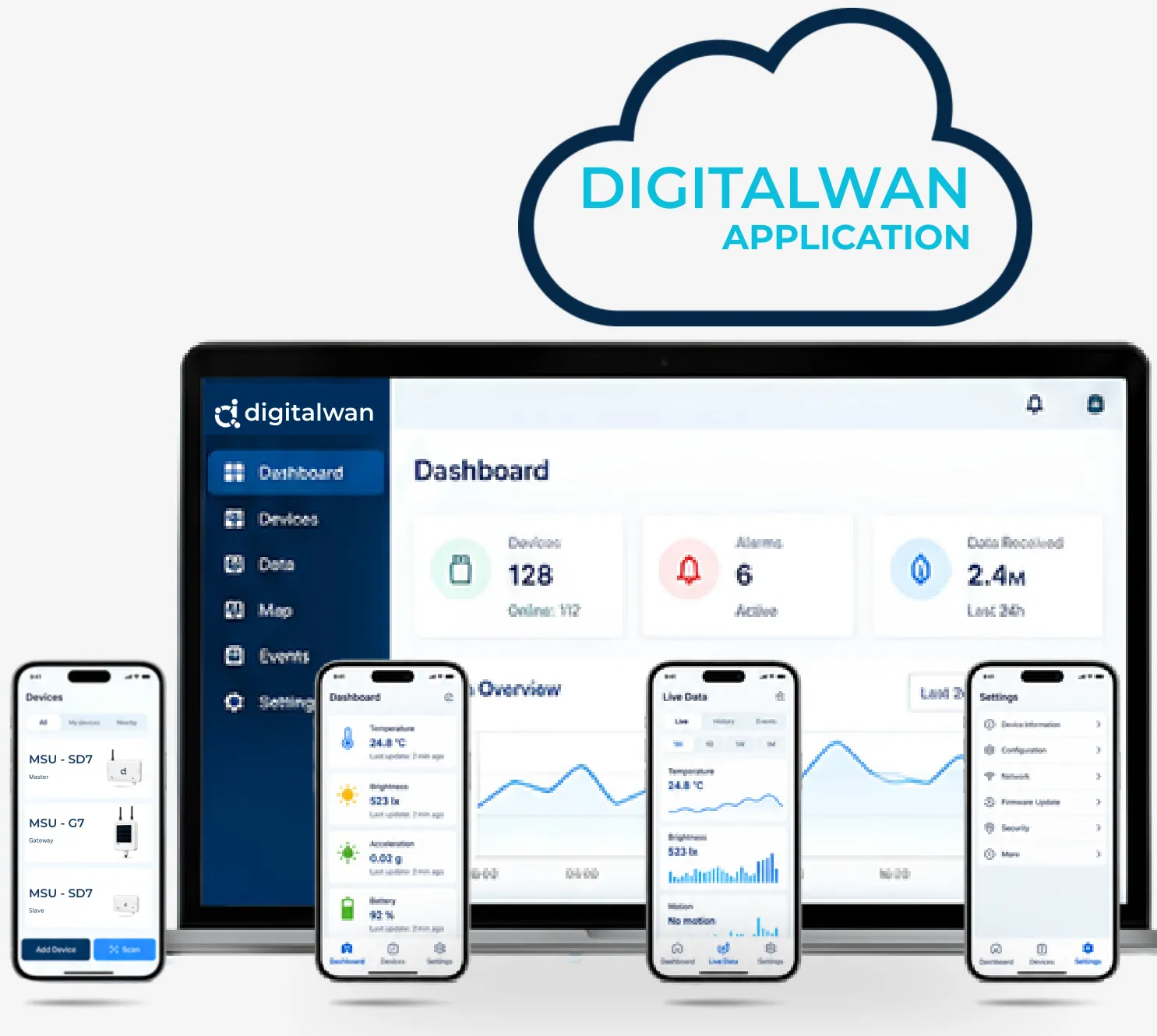
From data to decision — Digitalwan turns every connection into clarity, every sensor into intelligence and every asset into value.
Sense . Connect . Decide
Commitments
Designed for reliability, designed for autonomy, engineered for the future: four charters govern our activities.
The general principles that govern our activities, in line with professional standards and the law.
A continuous improvement approach to our organisation, in the spirit of the ISO 9001 standard.
An organisation-wide security approach based on the ISO 27001 standard.
A framework for using information systems and shared tools, for our teams and for external contractors alike.
Frequently asked questions
MSU-SD7 slave units transmit over LoRa to an MSU-MD7 master unit, or straight to the gateways over LoRaWAN. The master unit relays the data to an MSU-SG7 gateway over LoRaWAN 868 MHz, or straight to the platform through the mobile network over LTE-M or Cat-1 bis. The MSU-XD7 and MSU-LD7 standalone units communicate over LTE-M only, with no gateway or master unit.
No. Devices fitted with an eSIM transmit over the mobile network, with no local infrastructure. The MSU-SG7 gateway is useful for large sites, areas with poor coverage or deployments with many sensors.
An MSU-MD7 master unit handles up to 5 slave units, and an MSU-SG7 gateway collects master and slave units with no limit on the number of nodes.
Yes. The DigitalWan platform provides an API and secure access keys to feed the measurements into your business applications.
Yes. DigitalWan is an interoperable white-label solution that adapts to the needs and constraints of each company.
Yes. The information is synchronised across two separate transmission technologies, encrypted end to end and aggregated on secure platforms.
Tell us about your site and what you need to measure: we will point you to the right combination of sensors and send you a detailed quote.